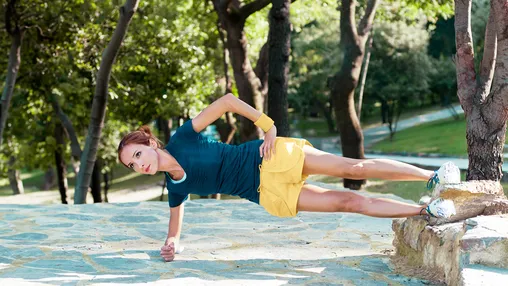
Core exercises like side planks offer strength and stability, and they help prevent injuries. But there’s one advanced variation that targets muscles regular side planks miss: the Copenhagen plank.
“A Copenhagen plank is a side plank variation in which one leg is supported on an elevated surface, such as a bench, while the other leg remains free, often held underneath the support,” explains Michael Fredericson, MD, a professor of orthopedic surgery at Stanford University in Stanford, California, and head team physician for the Stanford track and field and swimming teams.
This positioning makes the exercise especially valuable for athletes and active people. It challenges your entire core — including your rectus abdominus, obliques, transverse abdominus, pelvic floor, and lower back muscles — while uniquely targeting your inner thigh muscles (adductors). This combination helps maintain balance and stability during dynamic movements, from playing sports to carrying groceries.
What Is a Copenhagen Plank?
Named after FC Copenhagen, the Danish soccer team that popularized it, the Copenhagen plank is an advanced core exercise that offers advantages over a typical side plank, which is performed with both feet on the ground.[2] Both variations strengthen the obliques (the ab muscles on your sides) and rectus abdominis (the “six-pack” muscles), but the Copenhagen plank’s single-leg position uniquely challenges your hip adductors and abductors (outer thigh muscles). These muscles are essential for lateral movement and knee stability during sports and everyday activities.
Potential Benefits
The Copenhagen plank’s positioning challenges both your upper and lower body more intensely than traditional side planks. This builds greater strength in key muscle groups, improving athletic performance and reducing injury risk.
Improves Hip Strength and Health
Supporting your body with just one elevated leg rather than both feet on the floor puts far greater demand on your hip adductors, building strength and endurance in these often-neglected muscles.
“Strengthening the hip adductors is associated with a reduced risk of groin injuries and improved athletic performance, especially in sports that require rapid changes of direction,” explains Dr. Fredericson, which is why the exercise is popular among professional sports teams.
Research on 35 Norwegian semiprofessional football teams found that the average prevalence of groin injuries was nearly 8 percent lower during the season in those who performed the Copenhagen plank three times per week during the preseason period (six to eight weeks) and once per week during the competitive season (28 weeks) compared with those who did not do the exercise.[4]
The hip abductors also engage to stabilize the pelvis and prevent it from dropping while holding the bottom leg off the floor.[2]Strong hip abductors are essential for lateral stability and balance, helping prevent falls and improve performance during activities that require side-to-side movement.
Strengthens Core Muscles
As a unilateral exercise — one that targets one side of your body at a time — the Copenhagen plank can generate higher muscle activation in your core compared with standard planks, Fredericson says. One key reason is that you’re supporting your body unequally, which forces your core to work harder to keep your torso stable and to resist twisting or bending.
A stronger core reduces your risk of injuries — particularly in your lower back — and improves balance and stability, making everyday activities easier, from playing tennis to doing housework.
Improves Shoulder Health
The Copenhagen plank is performed with your arm supporting your body on your side. This position activates upper back and shoulder muscles — including the trapezius, infraspinatus, and serratus anterior — that help stabilize the shoulder joint.[8] Elevating your lower body on a bench shifts more of your weight toward your upper body, which significantly increases the strength-building stimulus on the supporting arm for greater results.
Stronger, more stable shoulder muscles help protect the joint from age-related decline and can cushion the impact during slips and falls.
How to Do a Copenhagen Plank
If you have cardiovascular issues, musculoskeletal pain or injuries, or other health conditions or injuries that interfere with your ability to safely exercise, talk to your doctor before attempting the Copenhagen plank to see if it’s appropriate for you, Fredericson says.
Use caution if you have a history of shoulder injuries. “It may be too challenging to hold the elevated side plank position,” explains Matt Kasee, CSCS, a certified strength and conditioning specialist in Cincinnati. And those with a history of knee issues may find that supporting one leg on an elevated surface is too stressful for their knees, Kasee adds.
To perform a Copenhagen plank:
Illustrative graphic titled Copenhagen Plank Lie shows on side with forearm and hand on floor, legs extended. Place top foot on box or bench. Raise hips off ground. Lift bottom foot. Hold. Everyday Health logo.
Everyday Health
Lie on one side with your bottom forearm and hand firmly on the ground, the elbow directly beneath the shoulder, and both legs extended.
Place the side of your top foot onto a sturdy box or bench.
Press the edge of your top foot into the surface of the box or bench and raise your hips off the ground to form a straight line from head to toe.
Lift the bottom foot off the ground so it hovers a few inches below the top foot.
Gaze forward while you hold this position.
“You can perform this in reps by raising and lowering your hips or holding your hips up for a set duration,” says Kasee. Start with 30 seconds or 10 reps per side and gradually increase the duration or number of reps as you get stronger.
Don’t let your hips sag toward the ground during the Copenhagen plank. This compromises your alignment and reduces the exercise’s effectiveness. Kasee says this is often because the hip adductors and core aren’t strong enough for the position. “To fix it, slide more of your top leg onto the support,” he suggests.
Another key mistake is shifting your torso forward, which Kasee says is often caused by insufficient strength in the core and shoulders. To fix it, he advises switching to a traditional side plank so you can build strength and endurance in the shoulder and core. Once you master the correct technique, you can try the Copenhagen plank again.
Copenhagen Plank Variations
For those with physical restrictions or who are newer to core training, start with basic core exercises loike side planks. Progress to a modified variation of the Copenhagen plank once you feel ready and able, Kasee says.
To perform a modified Copenhagen plank, bend your top leg and place your top knee on the bench instead of your foot. This simple tweak shortens the distance that your body has to support, making the exercise easier. “Then slowly lengthen the plank as you get stronger until only your ankle and foot are on the box,” Kasee suggests.
The Takeaway
No matter your age or fitness level, a strong core is vital to improve your balance and stability, increase athleticism, and prevent injuries.
The Copenhagen plank, named after a professional sports team from Denmark, is an advanced version of a plank that targets not only your core, but also your shoulders and hips.
If you have a history of injuries or are new to core training, start with basic plank variations first to build strength before advancing to the full version of the Copenhagen plank.